How did it impact social structures of English Society?
Although with the common knowledge that cross-dressing confronted the biblical law prohibiting the practice, it could still be evident in Early Modern English Society. Individuals who did practice cross-dressing were often punished for their transgressive actions. It was often that females in England would cross dress and would wear such appearances in public whereas men would solely cross dress within the environment of theatre. Cross-dressing was a theatrical tool due to the fact that women were restricted to participate on stage theatre, therefore a male actor was to dress as a female character to perform the play. As presented in past blog posts, gender fixated fashion was a vital aspect of continuation of social structures within England in Early Modern period. Supporting the idea that the women within England that practiced cross-dressing were challenging not only the patriarchy, gender roles and expectations but simultaneously these women were challenging social norms through dressing as they were. Early Modern beliefs of cross-dressing on stage compared to in public were counteractive to one another. As cross-dressing for theatrical purposes was supporting while cross-dressing for pleasure in the public eye was condemned and punishable. This double standard within Early Modern English society is an example of the power of the patriarchy of this time in history. As quoted by David Cressy discussed in class, women adopting male attire is described by historians as “represented as a challenge to patriarchal values, a bold assault on oppressive cultural boundaries” Furthermore, it supports the fact of socially organized expectations of both sexes during the Early Modern Period in the sense that conducting cross-dressing would be seen as transgressive because it was punishable by law.
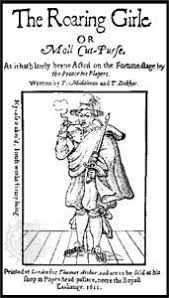
For women found cross-dressing, punishments varied from attending ecclesiastical court and having to reprimand through prayer or if gone through the process of common court, the most punishable would be forced into public penance. The case of Mary Frith, as portrays through The Roaring Girl, exhibits the possible extremes that an incident of cross dressing could cause where she could have been charged with lewdness and bawdry. Due to her pleading guilty to roistering because of her being seen in public in mens attire.
Women being seen in mens attire, otherwise known as cross-dressing, can be seen as a punishable offence as well as a factor for social rejection and exile. Depending on what class you are derived from, this finding and possibly charge could be very detrimental to an individuals social reputation in Early Modern England. Otherwise then being acceptable for a men in Early Modern England to cross dress for the reason of theatre performances. The transgressive actions performed by women through cross-dressing was in retaliation of the control of the patriarchy, this was heavily denied by society in England, therefore furthering their rejection by society.
Bibliography:
Cressy, David. “Gender trouble and cross-dressing in early modern England.” Journal of British Studies 35, no. 4 (1996): 438-465.
Dollimore, Jonathan. “Early Modern: Cross-Dressing in Early Modern England.” In Sexual Dissidence: Augustine to Wilde, Freud to Foucault. Oxford: Oxford University Press, 1991. Oxford Scholarship Online, 2011. doi: 10.1093/acprof:oso/9780198112259.003.0019.
Gilbert, Ruth. Early modern hermaphrodites: sex and other stories. Springer, 2002.
Gorman, Sara E. “The Theatricality of Transformation: cross-dressing and gender/sexuality spectra on the Elizabethan stage.” (2006).
Howard, Jean E. “Cross-dressing, the theater, and gender struggle in early modern England.” In Crossing the Stage, pp. 31-62. Routledge, 2005.
 The Fashion of Early Modern London