The limits, freedoms and inventions of fashion during the Elizabethan age.
The most evident fashion trends followed the time when Elizabeth I was the Queen of England. Queen Elizabeth I had such an influence on fashion to the point where there have been accounts of women risking their health to paint their skin white to indicate high status in society, similar to how Queen Elizabeth did. The Elizabethan period fashion trends are known for its concentration of costume design rather than the practicality. The clothing of this time is astounding, unmistakable, ravishing and lastly with no doubt, they were works of art. The elaborate fashions of the elite at this time inspired the working class to create their own fashions to mimic the elite clothing through embellishments, expensive fabrics, and sewing techniques. Elizabeth’s dresses were crafted with the best fabrics such as silk, satin and velvet. Fabrics for royalty were specifically coloured red such as russet red or a bright crimson red because the colour red dye was imported and reserved specially for the royals of the time to demonstrate their wealth and power in England.
During the reign of Elizabeth I, Sumptuary Laws were implemented into English society which played a massive part in what commoners would be allowed to wear in public during throughout their daily lives. On June 15th, 1574 Queen Elizabeth implemented the new Sumptuary Law named the “Statute of Apparel”. The Statute of Apparel was a way in which social structure was maintained throughout the late sixteenth century English society. These laws were imposed by those in power to limit and control the behaviour of English society through the restrictions put on clothing. Elizabeth’s sumptuary laws dictated the fabrics, colours and style of clothing an individual was allowed to wear depending on their class standing. This was a tactic to easily identify those of lower class compared to upper class. Many fabrics were restricted for the lower, middle and upper class for the pure reason to reserve for the royal’s use. Queen Elizabeth used the reasoning of this Sumptuary Law was to protect Britain’s economy due to the excessive spending on luxury items, in which clothing was considered one. Another justification of this law to hide the fact that it was implementing greater class divisions, was that Queen Elizabeth I was worried for young men, that they would drive themselves into debt which would impact the crime rates in England at this time. The evident underlying factor that pushed for this law to be imposed onto English society was that class distinction lines were being blurred through the use of clothing and Queen Elizabeth I had to implement a law to stop the progression. The Statute of Apparel reinstated the blatant division of class structures within England during the reign of Elizabeth I.
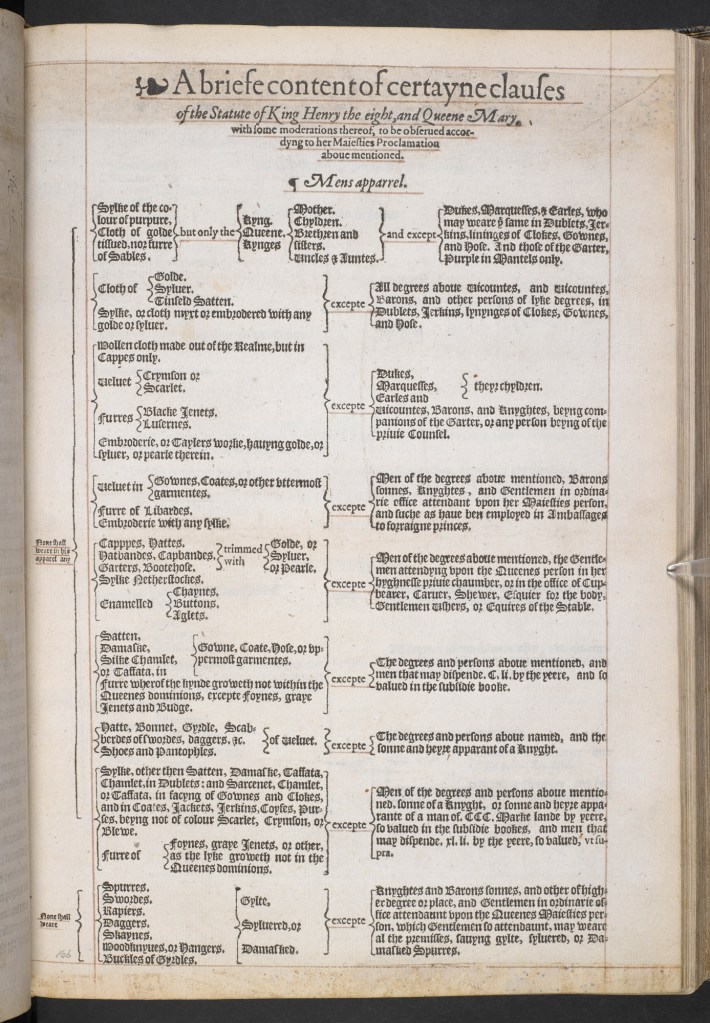
Many historians covering fashion during the Elizabethan age tend to focus on women’s fashion within this period of history because of the abundance of information on women’s fashion rather than male fashion. In contrast, men’s fashion had its own advancements and trends that are not as popularly covered. For men at this time, wearing the colour black especially in the form of fabrics mentioned above was symbolic of wealth and status in Early Modern England. As well, men’s doublets, which can be defined as close fitted, padded jacket, were improved for the elite class with the introduction of the use of leather within the doublet. Similarly, breeches that were worn by men for occasions such as court or an evening event, were improved through the use of leather.
With all of that said, the reign of Elizabeth I drastically changed the course of fashion trends in England throughout and following her time on the throne. With her inspiration into costume fashion then to reverting those elaborate fashions with the Statute of Apparel, those decisions have impacted the history of fashion for generations following.
Bibliography:
Dyson, H., & DYSON, Humphrey. (1618). A Booke containing all such Proclamations, as were published during the Raigne of the late Queene Elizabeth. Collected together by the industry of H. Dyson. B.L.
England Wales. Sovereign. By the Queene. The Excesse of Apparel, and the Superfluitie of Unnecessary Forreyne Wares Therto Belongyng, Nowe of Late Yeeres Is Growen by Sufferance to Suche an Extremitie … Early English Books, 1475-1640 ; 456:8. London: By Richarde Iugge, Printer to the Queenes Maiestie, 1574.
Evelyn, John. Tyrannus, Or, The Mode: In a Discourse of Sumptuary Lawes. Early English Books Online. London: Printed for G. Bedel, T. Collins …, and J. Crook …, 1661.
 The Fashion of Early Modern London