By: Abagail Williams
How did a soldiers style of uniform demonstrate their role within the military in Early Modern England?
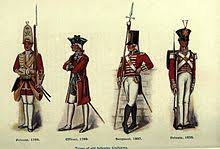
Uniforms, specifically speaking within the role of uniform in the military establishes a way of identification for countries on the battlefield as well as it establishes the sense of homogeneousness within the unit. Military uniforms that demonstrated this uniformity was not until after the military revolution between the years of 1560 to 1660. This revolution provided a drastic change to warfare, especially for the British army. Prior to the military revolution, there was only one form of uniform in British military culture which was the militia that held no official uniform and Yeoman of the Guard. During the civil war, the New Model Army adopted the red coats as a majoring characteristic of their uniform which then translated to England’s army following the civil war. From the perspective of a civilian, the reasoning for uniforms was for soldiers on the battlefield to distinguish their infantry from the enemy they are fighting against. This is factual but the implementation of uniforms within the British military was for the men within the unit to be able to identify their superiors and special commanders on the battlefield. In the beginning, it was only the unit’s commanders that wore a particular uniform for this reason of identification but it later spread to the dress of uniformity for all infantry levels. Explaining as to why particular roles within the military have fixed uniforms.
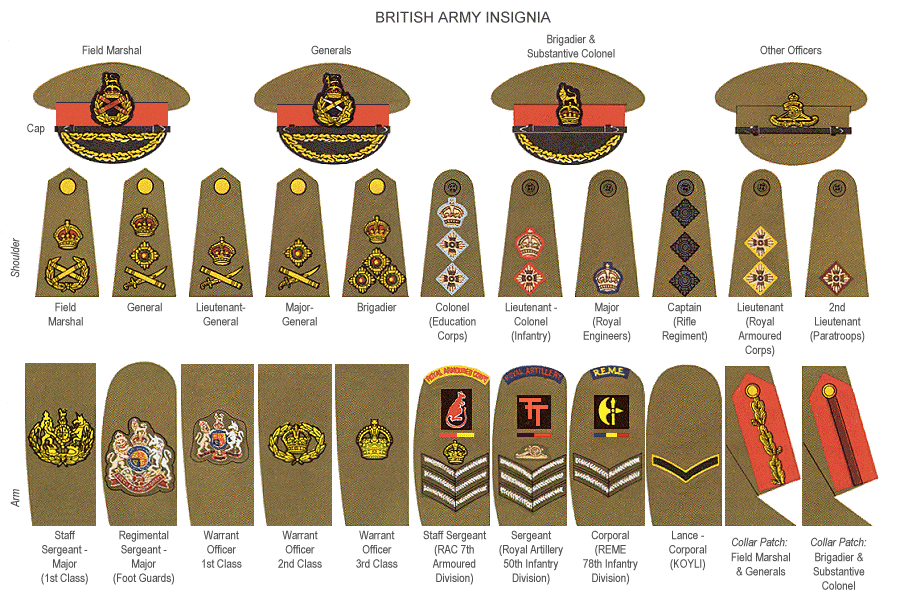
Particular roles such as grenadiers, cavalry, military academy soldiers, and liveries had distinct aspects of their uniform to be recognized by their men. Although these divisions of a unit were not intentionally created, it made an evident divide between subordinates and superiors within the British military. Meaning that depending on what uniform your are wearing in addition to the insignia emblem that is placed on your arm dictates your role within the military with little room to move up the ranks, similar to clothing in civilian society. Britain was and is still known for their infamous red military uniform, similar to France’s blue uniform, this colour of the uniform was adopted by the rest of the world to perceive their superiority on the battlefield. The Thirty Years War military uniforms for Britain translated into men’s everyday fashion through the style of clothing as well as the materials used. The dress code set out by the military after the military revolution has impacted dress codes that are evident today as a form of discipline sanctioned by political and economic institutions, the military being one. An example of this is dress codes for school uniforms, most evidently with private schools. This allows for the acknowledgement of being of higher status within society which can be apparent through military uniforms during the Early Modern Era in England.
Bibliography:
Howard, Michael. “The Military Revolution: Military Innovation and the Rise of the West, 1500–1800.” The Historical Journal 32, no. 1 (1989): 238-40.
Lawrence, David R. 2011. “Reappraising the Elizabethan and Early Stuart Soldier: Recent Historiography on Early Modern English Military Culture.” History Compass 9 (1): 16-33. doi:10.1111/j.1478-0542.2010.00748.x. http://resolver.scholarsportal.info/resolve/14780542/v09i0001/16_rteaesoememc.
Rogers, Clifford J. The Military Revolution Debate Readings on the Military Transformation of Early Modern Europe. History and Warfare. Boulder: Westview Press, 1995.
Roy, I. “Shorter Notice. The Civil Wars. A Military History of England, Scotland and Ireland, 1638-60. J Kenyon , J Ohlmeyer [edd].” The English Historical Review 115, no. 462, 727-28.
 The Fashion of Early Modern London