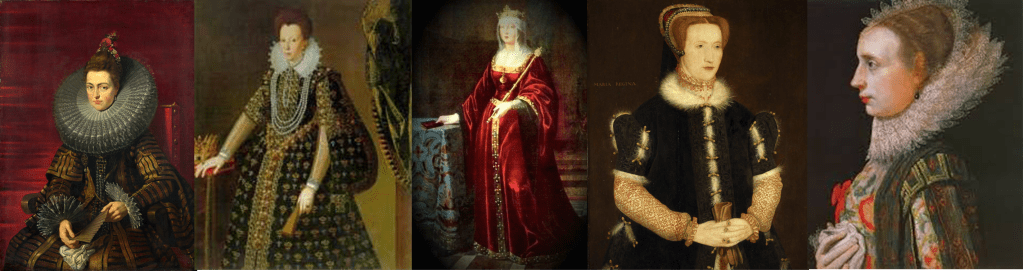
Considering the elaborate fashion trends of the Early Modern period, how did particular clothing styles and the quality of which they were produced, specifically detailing to women, translate to society what class they were involved in?
The rise in the symbolic meanings of fashion for individuals in Early Modern England increased the division of class structures within the country. Fashion in Early Modern England played a crucial role in an individuals daily life, as what they wore dictated to the public where they were accordance to the social hierarchy of the time. The Early Modern Era viewed fashion as a representation of an individual’s prominence in society on a daily basis, particularly considering the nobility and wealthy upper class. As quoted by the Earl of Chesterfield in a letter to his son on April 30th, 1750 he says, “If you are not in fashion, you are nobody.” This emphasizes the importance shown through what the Earl of Chesterfield has said to his son mentioning how crucial it was in the era of Early Modern England for your fashion choices, which depicted your social class. What an individual wore at this time can be considered a basis for ridicule or praise, depending on the quality of your outfit, the style of it and when it was worn. Distinguishing what style of clothing, where it was produced, and the materials used on such influenced a individuals and their family’s class in which it difficult to escape that label. Anthropologist Thomas Beidelman described the significance of fashion in Cloth and the Organization of Human Experience written by Jane Schneider and Annette B. Weiner, as “Cloths defines the limits and possibilities of people as actors in social relations.” This illuminates the positive and negative affects fashion has on individuals lives in England from the fourteenth century to the mid seventeenth century. Exhibiting that the clothes a man or woman wore during this time could greatly restrict their power and ability to act within society or it would be a tool used to rise within the social hierarchies of England. The study of fashion trends and the contrast of these trends in different levels of societal hierarchy can assist in defining the social climate between classes in Early Modern London, most evident with women during this time.
Bibliography
Buckley, Cheryl, and Hazel Clark. “Conceptualizing fashion in everyday lives.” Design Issues 28, no. 4 (2012): 18-28.
Gulick, Sidney L. “The Publication of Chesterfield’s Letters to His Son.” PMLA 51, no. 1 (1936): 165-77. doi:10.2307/458320.
Schneider, Jane, and Annette B. Weiner. “Cloth and the Organization of Human Experience.” Current Anthropology 27, no. 2 (1986): 178-84.
 The Fashion of Early Modern London